
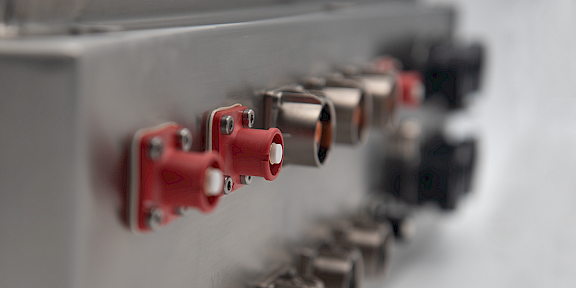
PDU – Power Distribution Unit Central power distribution in high-voltage and low-voltage versions
No vehicle moves without electricity today. While in the past it was only used to power lights, windshield wipers, and other small consumers, today all systems—from driving to infotainment and driver assistance systems—rely on a dependable power supply. In the course of electromobility, this dependence is being reinforced even further.
Consequently, the electrical/electronic architecture (E/E architecture) is becoming a key task in vehicle development, as the functional scope continues to rise sharply, complexity increases, and networking introduces new requirements. The E/E architecture includes, on the one hand, the control units or vehicle computers that monitor, control, and regulate vehicle functions using programmed algorithms. On the other hand, it also includes the onboard electrical system, which is responsible for both the power supply and the transmission of information between all electrical components.
However, the construct is not complete with computers, cables, and contacts alone. The consumers require a safe and reliable energy supply that distributes the currents to the consumers according to demand. Power distribution is a complex topic with the challenge of ensuring high reliability, avoiding losses, and guaranteeing safety for operators and users at voltage levels that could be classified as dangerous. This begins with simple distribution boxes featuring relays and fuses and ends with highly complex high-voltage distributors with different voltage levels due to integrated converters, smart power switches, integrated safety electronics, and the integration of heat flows into thermal management. Reliability is a central issue, and monitoring, including self-monitoring of critical components, provides possible solutions.
Designs using conventional wiring technology or PCB solutions in soldering and press-fit technology, with onboard intelligence, active or purely passive, 100% customized, installed in housings or mounting frames, protected against environmental influences, and designed for quick and easy installation as well as optimal service. The solutions are as diverse as the vehicles they equip. And in the course of electric powertrains, where high currents exceeding 600 A are routed, new challenges arise. When the current-carrying capacity of printed circuit boards is no longer sufficient and cable cross-sections become too unwieldy, busbars can be used. Here, structural requirements stand alongside electrical ones. These challenges are also linked to a good knowledge of materials regarding cables, connections, insulation, and housings. In general, thermal monitoring is of great importance, as high temperatures do not only lead to wear and reduced service life. In extreme cases, uncontrolled heat generation can lead to a fire. The identification of risks as well as the verification and validation of measures are necessary steps in the concept and development phase.
Based on our technologies and experience, we can work interdisciplinarily and support you from conception through development and prototyping to series supply. We can offer a solution tailored to your requirements. Our product range includes everything from cable assembly and high-voltage cable harnesses to complete onboard electrical systems, from populated printed circuit boards and analog controls to computer-based automotive control units and safety electronics, and from busbars and brackets to complete metal housings—all manufactured in-house.
At Wölfle, you will find support over the entire life cycle, including technical and logistical support, service competence, and the availability of spare parts over the entire service life.