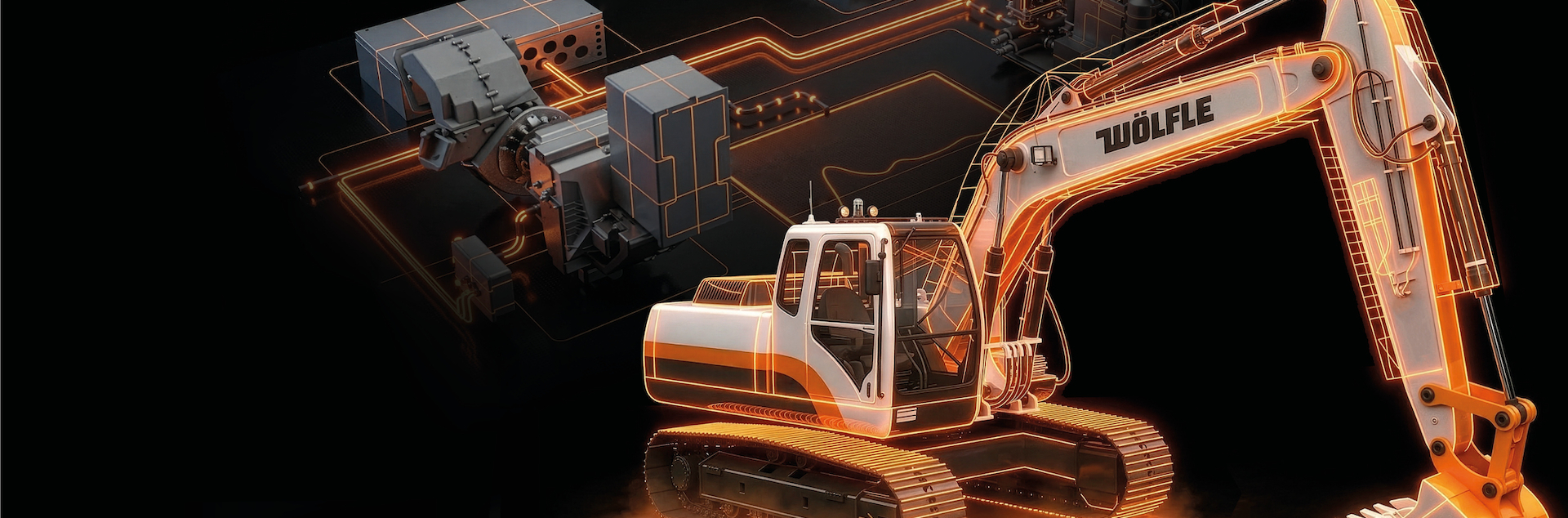
Thermal Management Holistic thermal management for modern vehicles and machines
Thermal management is a key system discipline in the development of modern vehicles and machines.
It describes the controlled management of heat flows within components such as batteries,
power electronics, and cabins – directly impacting efficiency, lifetime, and overall performance.
Different operating conditions, varying environmental influences, and increasing electrification
lead to complex interactions that cannot be considered in isolation.
Wölfle therefore approaches thermal management as an integrated overall system.
By combining extensive experience in electromobility with advanced climate and simulation models,
we analyze thermal interactions at an early stage and make them controllable throughout the development process.
-
System Integration
Holistic approach
-
Temperature Control
<1K accuracy
-
Energy Model
Early simulation and system design
-
Maximum Range
Efficient use of thermal energy
Temperature Management When theory reaches its limits
In vehicle development, energy flows often behave differently in real operation than predicted by theory.
Thermal management concepts therefore need to be adapted or redefined.
We take these effects into account already during the modeling phase:
Based on advanced climate and simulation models, we represent real load cases, performance levels, and temperature requirements at an early stage.
Heat for the cabin, battery, and components must be generated electrically – which can significantly reduce range or operating time under unfavorable conditions.
This is exactly where our approach comes in.
Thermal Requirements Many components. One integrated system.
Modern electric vehicles combine numerous components with different thermal requirements:
- Batteries require a narrow temperature window – high temperatures reduce lifetime, low temperatures decrease performance and efficiency.
- HVAC systems ensure passenger comfort but operate at different temperature levels.
- E-motors & power electronics generate continuous heat and require reliable overheating protection.
- Fuel cells also generate heat that must be dissipated.
Thermal management goes beyond simple cooling. Heat must be intelligently used, generated, and distributed.
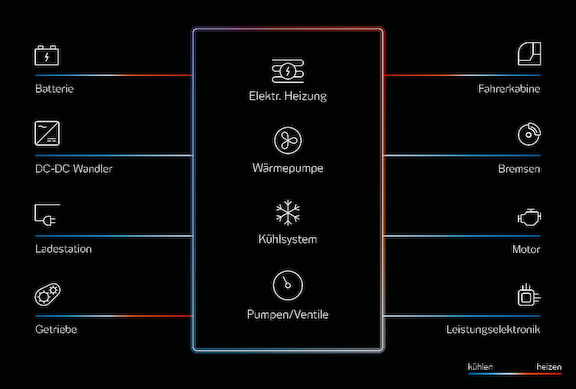
We therefore consider all relevant systems – from water and refrigerant circuits to airflow and convection – and integrate technologies such as heat pumps, electric heaters, or thermal storage depending on the application.
The result is a holistic thermal management system that efficiently combines all requirements.
Holistic Thermal Management OUR APPROACH
Our holistic thermal management model can be flexibly adapted to different vehicle architectures.
The patented system integrates each component according to its performance and temperature level.
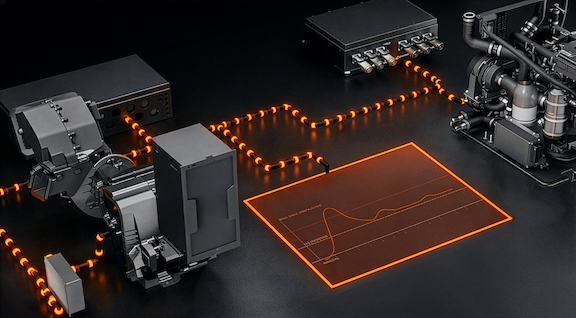
A central control unit coordinates the entire system based on model-based control strategies.
Heat demand, temperature levels, temperature uniformity, and control accuracy are continuously considered to distribute energy efficiently and integrate additional components such as heat pumps or electric heaters where needed.
Model-Based Development MEASURABLE VALUE
Our thermal management systems can be integrated already in early prototype vehicles.
During testing, we collect and analyze measurement and model data directly within the vehicle.
Based on this, we create well-founded cost-benefit analyses and identify at an early stage which system interactions are most effective for series production.
With our thermal management solutions, our customers achieve:
- extended range and operating time
- efficient heating, climate, and comfort functions
- increased lifetime of battery, electronics, and drivetrain
- improved efficiency and emission performance
- advanced functions such as preconditioning or charging cooling
At the same time, we always keep costs, installation space, and technical feasibility in focus.