F-Gases in Transition Impact on vehicle air conditioning systems and mobile off-highway applications
Until the 1990s, automotive air conditioning systems were operated using the refrigerant R12. It belongs to the halogenated hydrocarbons within the CFC (chlorofluorocarbon) group of substances. These gases exhibit a high ODP (Ozone Depletion Potential). As a result, the ozone layer in the atmosphere is depleted, leading to increased UV radiation on Earth.
With the 1987 Montreal Protocol, which was signed by many countries, including the USA and the Commission of the European Community, the global phase-out of CFC production began. The use of R12 in automotive air conditioning systems has been banned since 1996.
From R12 to R134a – The Development of Refrigerants
134a was primarily used as a replacement and successor refrigerant. This refrigerant is a hydrofluorocarbon and contains no chlorine. Therefore, it no longer possesses any ozone depletion potential. However, the disadvantage of this refrigerant is its high GWP (Global Warming Potential). The greenhouse effect of R134a is 1430 times higher compared to carbon dioxide.
Since 2011, refrigerants with a global warming potential greater than 150 may no longer be used in the air conditioning systems of newly introduced vehicle types. Since January 1, 2017, their use is banned in all new vehicles. This was decreed in Directive 2006/40/EC and applies to motor vehicles of categories M1 and N1. Regulation (EC) No 842/2006 forms the framework for the general regulation of fluorinated hydrocarbons, which Directive 2006/40/EC specifies for use in motor vehicles.
F-Gas Regulation and Phased Reduction of Availability
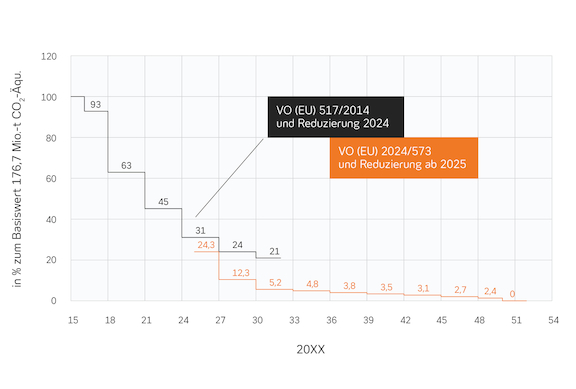
Regulation (EU) 517/2014 restructured the availability of hydrofluorocarbons (F-gases) and limited it through quotas. For this purpose, an average value in tonnes of CO₂ equivalent was established, based on the quantities of F-gases placed on the market from 2009 to 2012. This average value was set as 100% in 2015. Subsequently, a phased reduction to 21% by 2030 was planned by limiting the quantity placed on the market.
As a result, the availability of F-gas-based refrigerants is decreasing. This leads to price increases and heightens the pressure on all applications using these substances to switch to alternative solutions. The new Regulation (EU) 2024/573 further tightens the reduction steps and pursues the goal of a complete phase-out of F-gases by the year 2050.
What Are the Implications for Mobile Off-Highway Applications?
All previous regulations and directives do not currently mandate specific restrictions on the use of F-gases in mobile equipment.
These include, among others:
-
Heavy-duty vehicles
-
Vans
-
Mobile machinery and non-road equipment
-
Agricultural applications
-
Mining applications
-
Construction applications
-
Trains
-
Subways
-
Trams
-
Aircraft
The EU Commission intends to publish a report by July 1, 2027. Until then, an assessment will be conducted to determine whether cost-effective, technically feasible, energy-efficient, and reliable alternatives for fluorinated greenhouse gases are available in mobile refrigeration and air conditioning systems.
The results of this assessment may have direct implications for the mobile sector.
New Requirements for Leak Check Controls
Regulation (EU) 2024/573 also updated the threshold values for leak check controls. Leak checks are required for systems containing hydrofluorocarbons, such as R134a, with charge sizes of more than 5 t CO₂ equivalent, as well as for HFOs, such as R1234yf, with charge sizes of more than 1 kg.
These leak checks will also become mandatory for mobile systems in off-highway applications starting in March 2027. The required checks can be carried out within the scope of regular maintenance intervals.
Differences Between Europe and the USA
The regulations in the USA differ from European specifications in several points.
Under the US AIM Act 2020, the ban on placing refrigerants with a GWP of more than 150 on the market will apply to the MVAC (Motor Vehicle Air Conditioning) sector from January 2028. This also affects the subsector of nonroad vehicles.
This category includes, among others:
-
Agricultural machinery
-
Construction machinery
-
Mining vehicles
-
Municipal vehicles
Furthermore, hydrocarbons such as propane (R290) are not approved for use in MVAC applications in the USA. Propane belongs to safety class A3 and exhibits higher flammability. Currently, only R1234yf and R744 are approved for mobile use in the USA. The refrigerant R1234yf is also flammable, but falls into safety class A2L. This means it is mildly flammable but has a low burning velocity.
R1234yf, PFAS, and Future Developments
In summary, a trend toward R1234yf as the standard refrigerant for mobile applications can be observed. At the same time, the decision regarding PFAS substances is still pending in European legislation.
PFAS are per- and polyfluoroalkyl substances as well as substances that are proven or suspected to degrade into PFAS. When HFOs like R1234yf degrade in the atmosphere, they form TFA (trifluoroacetic acid), which in turn belongs to the group of PFAS substances.
The current discussions at the EU level regarding a PFAS initiative within the framework of the REACH Regulation can therefore have significant impacts on the refrigerant sector. A corresponding regulation is currently expected in the period between 2027 and 2028.
Safety Requirements for Flammable Refrigerants
Since both R1234yf and propane (R290) are flammable substances, a risk assessment should already be carried out during the design phase.
The disadvantage of propane lies in its high flammability. It belongs to safety group A3 according to DIN EN 378-1 and is therefore subject to special safety requirements.
However, with appropriate safety precautions, systems can be operated safely—depending on the intended areas of application. This is also demonstrated by practical experience gained from the long-term operation of such systems.
Conclusion
The regulatory requirements for fluorinated refrigerants are continuously evolving. While the availability of classic F-gases is being gradually reduced by European regulations, mobile air conditioning systems and off-highway applications in particular face future technical and regulatory changes.
In particular, further developments surrounding Regulation (EU) 2024/573, the assessment of alternative refrigerants by 2027, and potential PFAS regulations will decisively influence the future selection and use of refrigerants.