air condition or heat pump What is the difference?
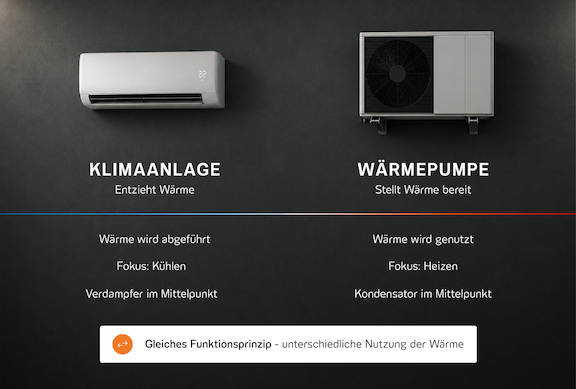
Heat pumps and air conditioning systems are based on the same fundamental thermodynamic principle. Both systems utilize a closed refrigerant circuit to transport heat. Nevertheless, heat pumps and air conditioning systems differ in their actual function.
The decisive difference lies in the direction of the heat transport and which side of the process is utilized for the application.
The Common Operating Principle of Air Conditioning Systems and Heat Pumps
Both heat pumps and air conditioning systems in vehicles are based on the principle of the compression refrigeration system.
In this process, a refrigerant undergoes various changes of state within a closed circuit. Through the cyclical change of the aggregate state, heat can be absorbed, transported, and released again.
In the evaporator, the refrigerant is evaporated at low pressure. During this process, it absorbs latent heat from the surroundings, thereby cooling them down.
The now gaseous refrigerant is subsequently brought to a higher pressure and temperature level by a compressor.
In the downstream condenser, the liquefaction of the refrigerant takes place while releasing heat to the surroundings.
Subsequently, the refrigerant is expanded via an expansion device, such as a throttle valve. This lowers the pressure and temperature again before the cycle begins anew.
What is the difference between a heat pump and an air conditioning system?
The fundamental difference between a heat pump and an air conditioning system lies in the respective direction of use of the process.
In an air conditioning system, the heat extracted in the evaporator is used for cooling. The objective is to remove heat from the vehicle interior or from a system.
In a heat pump, on the other hand, the heat released in the condenser is specifically used for heating.
Both systems therefore operate according to the same physical principle, but utilize different sides of the thermodynamic process.
Reversible Operation: Heating and Cooling with One System
By utilizing a reversible refrigerant circuit, a system can be operated in both heating and cooling modes.
This so-called reversible operation is implemented, for example, via a four-way valve. This allows the functions of the evaporator and condenser to be reversed.
A single system can thus either provide heat or remove heat, depending on the operating state.
Efficiency of Heat Pump Systems
Electrical auxiliary energy is required to operate a heat pump or air conditioning system. This is needed in particular for the compressor as well as for ancillary components such as fans or pumps.
Energy efficiency is typically described by the Coefficient of Performance (COP).
Under typical operating conditions, it can be roughly assumed that about 25% of the energy used is expended as drive energy, while around 75% of the usable heat output comes from the environment, for example from air or waste heat.
This high proportion of environmental energy contributes significantly to the good efficiency of heat pump systems.
If the electrical drive energy is additionally provided from renewable sources, balancing-neutral, emission-free operation is possible.
Heat Pumps and Air Conditioning Systems for Mobile Applications
Particularly in mobile applications, the demands on energy efficiency, installation space, performance, and system integration are continuously increasing.
Standard solutions often offer rapid availability and low initial costs. At the same time, however, they frequently reach their limits when faced with specialized requirements, limited installation space, or high efficiency demands.
As a development partner for thermal management systems, Wölfle develops vehicle-specific solutions that are tailored to the respective requirements of the application. This allows air conditioning and heat pump systems to be optimally integrated into the overall system.
Conclusion
The difference between an air conditioning system and a heat pump does not lie in the basic design, but in the utilization of the thermodynamic process.
While air conditioning systems remove heat for cooling, heat pumps specifically use the released heat for heating. Thanks to reversible refrigerant circuits, modern systems can combine both functions into a single solution, thereby enabling efficient temperature control for a wide variety of applications.