Heat pumps are among the most efficient heating systems available. Nevertheless, one statement often causes confusion: the efficiency of a heat pump can apparently exceed 100%. At first glance, this seems to contradict the law of conservation of energy. But how can this be explained?
What Does the Efficiency of a Heat Pump Mean?
In general, efficiency describes the ratio of useful energy output to energy input. According to this definition, efficiency cannot exceed 100%. Furthermore, the law of conservation of energy states that energy can neither be created nor destroyed. It can only be converted from one form into another.
Why Can a Heat Pump Achieve Values Above 100%?
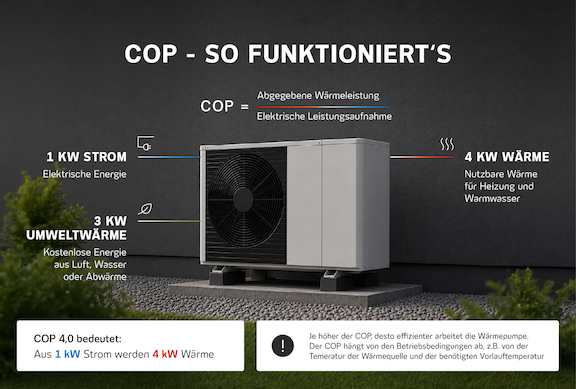
The key difference lies in the operating principle of a heat pump. It does not generate additional energy but instead utilizes existing ambient heat from sources such as air and waste heat. Using electrical energy, this ambient heat is raised to a higher temperature level and made available for heating purposes.
The electrical energy supplied is primarily required to drive the compressor and other components. The additional ambient heat, however, is taken from the environment and is not considered part of the supplied energy.
As a result, the heat output can be significantly higher than the electrical power input.
COP Instead of Conventional Efficiency
For this reason, conventional efficiency is not used to evaluate heat pumps. Instead, the Coefficient of Performance (COP) is applied.
The COP describes the ratio of heat output to electrical power input:
COP = Heat Output / Electrical Power Input
For example, a COP of 4 means that 1 kW of electrical power input provides a total heat output of 4 kW.
Why Are Operating Conditions So Important?
The COP of a heat pump depends heavily on the operating conditions. In particular, the temperature of the heat source plays a crucial role. The more favorable the temperature conditions, the more efficiently the heat pump operates. Therefore, COP values should only be compared when they are measured under identical operating conditions.
Conclusion
Heat pumps do not achieve efficiencies above 100% in the classical physical sense. In addition to the electrical energy supplied, they utilize ambient heat, enabling them to provide several times the input energy as useful heat.
For evaluating the performance of a heat pump, the Coefficient of Performance (COP) is therefore the key parameter. It indicates how effectively a heat pump converts electrical energy into usable heat while incorporating renewable ambient energy.