
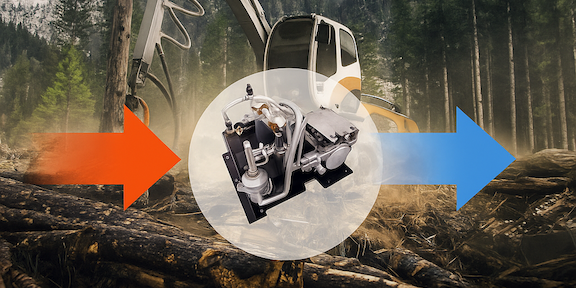
heat pump The energy-efficient solution for heating the driver's cab
How can the cabin of an electric vehicle be heated when there is no waste heat from the combustion engine? The energy source of an electric vehicle provides electricity, and electricity can be converted into heat. The direct method uses electrical resistance; every conductor carrying current generates heat when the current flows. In most cases, this method is not useful for its intended purpose and must be dissipated as waste heat. However, if heat generation is desired, this method, resistance heating, can be used, and if only the consumer side is considered, without losses during generation and transport, etc., it has a good efficiency of over 95%.
In mobile electric vehicles, it must be considered that the energy used to generate heat comes from the battery and thus reduces the available propulsion energy. The impact of heating on the range of an electric vehicle depends on several factors, some of which are vehicle-specific and some of which are usage-dependent. As an example, we can use the following values for an estimate. Heating the cabin air requires a heating output of 3 kW – 5 kW, and the energy consumption of an electric vehicle per 100 km is 15 kWh – 20 kWh. We can therefore see that heating the cabin directly results in a loss of range, namely over 20%. Reducing energy consumption for heating leads to an improvement in a vehicle's operating efficiency.
Using a heat pump can reduce energy consumption; even with a COP (coefficient of performance) of 2, this means halving the electrical energy required for heating and thus halving the loss of range.
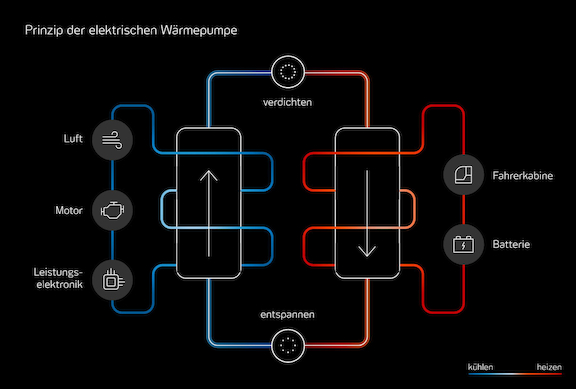
Heat pumps harness environmental heat and convert it into energy for heating vehicles. The operating principle is similar to that of a vehicle's air conditioning system, except that heat is used instead of cooling.
However, there is no single solution, because not all heat pumps are the same.
The distinction begins with the heat source from which the energy is generated and also includes heat dissipation and the distribution system. In a vehicle, the main source of environmental heat is the ambient air. In many cases, it makes sense to integrate the waste heat from various components, such as the battery, power electronics, drivetrain, etc., into the system and use it as a heat source. Heat can be released directly via the air, for example, to heat the cabin, or a coolant can be used in a distribution circuit to distribute the heat. Furthermore, reversibility is also an option; this allows the heat pump to reverse its operating direction, allowing it to be used for both heating and cooling.
The architecture of the thermal systems must be adapted to the specific conditions of the machines. The requirements for on- and off-highway machines are more diverse than in the automotive and commercial vehicle sectors. It is important to identify the optimal combination of options through simulation as early as the concept phase in order to be able to use them effectively for the application. The control of the system, which collects usable energy and uses it for operation through a sophisticated distribution system. Because not only the driver benefits from a pleasant climate, the battery also requires a constant, moderate ambient temperature to deliver full performance, this control is very complex and requires extensive experience in both thermodynamics and software-guided control technology.
With our simulation-based engineering, we work with system behavior models to find the right solution for your requirements. This approach allows us to identify early on how the components and systems, including the control system, perform their tasks. This also accelerates implementation in a real system. At our Wölfle test center, we have dedicated test benches and can obtain real measurement values under defined conditions. We use the real measurement data together with the simulation data and our expertise to optimize the systems. This development process minimizes costly testing in real-world operation.
If you are looking for a customized, efficient solution, not just any heat pump, then we should work together.
Simulationsbasiertes Engineering bei Wölfle
Mit simulationsbasiertem Engineering arbeitet Wölfle mit Verhaltensmodellen des Gesamtsystems, um die optimale Lösung für jede Anwendung zu entwickeln. Bereits früh im Entwicklungsprozess wird sichtbar, wie Komponenten, Systeme und Steuerung zusammenwirken.
Das beschleunigt die Umsetzung in reale Anwendungen erheblich. Im Wölfle Testzentrum stehen spezifische Prüfstände zur Verfügung, mit denen reale Messwerte unter definierten Bedingungen ermittelt werden. Diese Messdaten werden gemeinsam mit Simulationsergebnissen und technischem Know-how genutzt, um Systeme gezielt zu optimieren. Dadurch kann die kostenintensive Erprobung im Realbetrieb deutlich reduziert werden.
Maximale Effizienz beginnt mit dem richtigen System
Standardlösungen stoßen schnell an ihre Grenzen. Wir entwickeln Wärmepumpensysteme, die exakt auf Ihr Fahrzeug
und Ihre Anforderungen abgestimmt sind. Lassen Sie uns gemeinsam die optimale Lösung realisieren.