
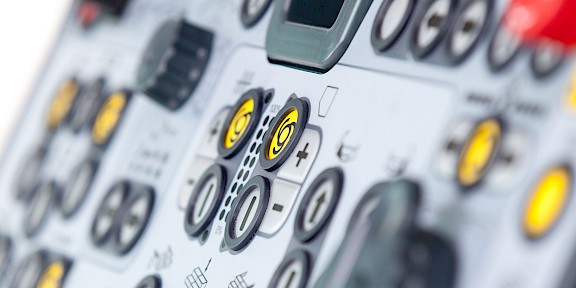
Operating systems / HMI Vehicle operation – compact, intuitive, and practical
Communication is not only a cultural process by which information is stored, processed, and redistributed among humans (Vilém Flusser – Communicology). The smooth functioning of a machine also depends on how human and machine communicate and interact with each other.
Every object that stands in an interaction with other objects has one or more interfaces through which information can be exchanged. In the case of machines, these are called user interfaces, through which a machine can be operated and monitored.
The utility and thus also the success of a machine depend significantly on its usability. If the possibilities offered by a machine cannot be utilized because the operation is not optimally designed, then the user does not get the performance they expect.
The best operation is when a required function can be clearly started and the operator receives an equally clear feedback on the process. In other words, an on/off switch with a status indicator. With complex machines, unfortunately, this can no longer be represented so simply, and the more complex the machine, the more highly developed the operating system must be.
Since your machines are specific and unique, the operation must also be specially adapted to them. Therefore, the operation cannot be standard; only operating systems optimally tailored to your requirements can make the complexity manageable. Essential characteristics of the machine, such as usability, safety, reliability, etc., are decisively co-determined by the operating system.
An operating system or HMI is an overall system consisting of an optical enclosure, input system, display system, electronic processing system, software, and electrical connections. Systems are only convincing if the interplay of these elements with technologically very different requirements is coordinated.
Especially in mobile applications, very diverse demands are placed on the housings. The requirements regarding stability, tightness, media resistance, etc., must be harmonized with design and functionality. This requires great expertise in material selection, creative design engineering skills, and a lot of experience, which impacts the timeline, development, and testing costs.
The possibilities in software implementation today are almost limitless. If safety, availability, and sustainability through scalability, portability, and maintainability are important to you, then AUTOSAR is an ideal software architecture. This open industry standard is a proven operating system for software solutions in the automotive sector. However, the effort required for implementation under AUTOSAR is not justified for every application. Together we can make the right choice; our expertise and experience cover a wide field of application. In software development, specialist and industry knowledge play a major role in achieving a user-friendly design of the systems.
With our interdisciplinary teams, we coordinate and manage all requirements at the level of mechanics, electrics, electronics, and software. Regardless of the size and complexity of the task, we offer you a customized overall solution for your application.
This simplifies implementation for you thanks to clear regulations regarding scope, strategy, and responsibilities, as well as our orientation toward our customers' practices.
This brings you security through our future-oriented technology and consistent support throughout the entire product life cycle.
Through our rule-based development processes, we can ensure optimal, practice-oriented solutions with a high quality standard.
Wölfle, the system provider for operating systems.