

heat pump Not all heat pumps are the same. This is how they differ in technology, functionality and efficiency.
The Energy-Efficient Solution for Heating the Driver's Cab
How can the cabin of an electric vehicle be heated when no waste heat from an internal combustion engine is available?
The energy source of an electric vehicle supplies electricity – and electricity can be converted into heat. The direct method works via electrical resistance: every conductor carrying a current generates heat when current flows. In most cases, this does not correspond to the actual purpose and must be dissipated as heat loss.
However, in the case of targeted heat generation, this method – resistance heating – can be used. Looking exclusively at the consumer side (excluding losses during generation and transport), it achieves an efficiency of over 95%.
Influence of Cabin Heating on Range
In the case of mobile electric vehicles, it must be taken into account that the energy for heat generation comes from the battery and thus reduces the available propulsion energy. The influence of heating operation on the range of an electric vehicle depends on several factors – both vehicle-dependent and usage-dependent.
For context:
-
Cabin heating capacity: 3 kW – 5 kW
-
Vehicle energy consumption: 15 kWh – 20 kWh per 100 km
This makes it clear: heating the cabin directly leads to range losses of over 20%. A reduction in energy consumption for heating therefore directly improves the operating efficiency of the vehicle.
Heat Pump as an Efficient Solution
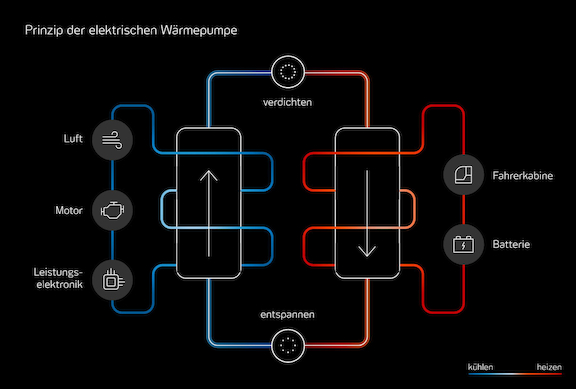
By using a heat pump, energy consumption can be significantly reduced. Even with a COP (Coefficient of Performance) of 2, the electrical energy required for heating is halved – and with it the loss of range. Heat pumps use ambient heat and convert it into energy for heating vehicles. The operating principle corresponds to that of an air conditioning system, with the difference that heat is used instead of cold.
Not all Heat Pumps are the same
There is no single solution – not all heat pumps are the same. The differences begin with the heat source and extend to the heat release and the distribution system.
Possible heat sources:
-
Ambient air
-
Waste heat from battery
-
Power electronics
-
Drivetrain
Heat release and distribution:
-
Direct air heating (cabin)
-
Coolant circuit for heat distribution
Additional functions:
-
Reversibility (heating and cooling in one system)
Thermal System Architecture in the Vehicle
The architecture of thermal systems must be adapted to the respective machines. Especially in the on- and off-highway sector, the requirements are significantly more diverse than in the classic automotive sector. Early simulation in the concept phase is crucial in order to identify and efficiently implement the optimal system combination. A central element is the system control: it collects usable energy sources and distributes them purposefully within the system. Not only do drivers benefit from a stable climate – the battery also requires a constant, moderate temperature to provide its full performance. The control of such systems is highly complex and requires deep expertise in:
-
Thermodynamics
-
Software-based control engineering
Simulation-based engineering at Wölfle
With simulation-based engineering, Wölfle works with behavioral models of the overall system to develop the optimal solution for every application. Early in the development process, it becomes visible how components, systems, and controls interact.
This significantly accelerates implementation into real-world applications. Specific test benches are available in the Wölfle test center to determine real measured values under defined conditions. These measurement data, combined with simulation results and technical know-how, are used to optimize systems in a targeted manner. As a result, cost-intensive testing in real operations can be significantly reduced.
Maximum efficiency begins with the right system
Standard solutions quickly reach their limits. We develop heat pump systems that are precisely tailored to your vehicle
and your requirements. Let us realize the optimal solution together.